Showing posts with label Florida State Parks. Show all posts

Friday, January 27, 2012

Manatee Springs State Park, Chiefland

Manatee Springs

11650 N.W. 115th Street
Chiefland, Florida 32626

(352) 493-6072


8:00 a.m. until sundown, 365 days a year

$6.00 per vehicle. 2-8 people per vehicle; $4.00 Single Occupant Vehicle; $2.00 Pedestrians, bicyclists, extra passengers, passengers in vehicle with holder of Annual Individual Entrance Pass.
Diving: spring, open water and cave diving. All divers are required to register with the office prior to diving. All divers must be registered by 3:00 p.m. and out of the water and checked out (c-cards returned) by 5:00 p.m.
Pavilion Rental, Camping, Organized Youth and Adult Group Camping fees apply.  See web-site.
 
 
(From the Web-site): The first-magnitude spring at this park produces an average of 100 million gallons of clear, cool water daily. In winter, West Indian manatees swim upriver to the warmer waters of the springs. Popular for snorkeling and scuba diving, the headwaters of the spring are also a great spot for swimming. The spring run forms a sparkling stream that meanders through hardwood wetlands to the Suwannee River. Canoe and kayaks can be rented May through September. Children enjoy the playground in the picnic area. Hiking and bicycling are available on the north end trail system. The full-facility campground is surrounded by red oak woods.

To continue our day's adventure with Don, Peg, Lynne, Steve and me, Steve's idea was to visit an altogether different state park. So, we followed the rural roads of Alachua and Levy Counties and meandered our way to Chiefland.

By this time, Don's and Peg's early morning McDonald's breakfast had worn off. Steve is not known for stopping. When he is focused on getting somewhere, that's it. Well, with four against one, we talked him into stopping. We went through Newberry.. There is a little hole-in-the-wall restaurant. Lynne had been there before and did not really want to go back to it.
Our morning adventure continued.  Miles and miles of trees, cattle and more trees, we finally came to outskirts of Trenton (no, not New Jersey…Trenton, Florida…the County Seat of Gilcrist County…yeah, I know y’all never heard of it).  SUBWAY.  Yeah! Food!  Not terribly exciting, but it would do.  Don treated all of us.  Steve and I split a BLT sub (or as we call it in Southern New England—grinder) which was surprisingly quite good.
Continuing on to Chiefland, we followed the signs to the springs.  Well, actually Steve knew where it was, so the signs were not necessarily necessary.  
Steve at times can be a conniver.  First he told the man at the gate (this one is “manned”) that we had already been to a State Park.  That did not matter.  Then, Steve asked him if his volunteering at another State Park would help.  The guy wanted proof.  Well, as it were, he has a Silver River Museum volunteer placard on the dashboard. VoilĂ©.  That seemed to be good enough to get a complimentary pass.
A boardwalk follows the Suwanee River with several overlooks.  It ends at a boat ramp.  Normally, in the winter, there are many manatee.  But, this has been a rather warm winter.  So, they have not sought the warmth of shallow and temperate waters of the “springs.”  We did not see any. Also, the day was hazy, so the blue sky did not show its unfailing beauty.  The many examples of flora (most trees) had shade their leaves.  This gives the landscape a much more dreary look than one might see any other season (yes, we do have seasonal changes, albeit not as dramatic as it is “up north.”).
We followed the boardwalk, spent quite some time taking in the quietness.  We back tracked and went to the Springs portion of the park.  The colors were not as vibrant as we have seen them, but everyone enjoyed the serene nature of the place.  Fauna observed was a gazillion turkey buzzards in the trees and two snakes nestled around two branches in a bush in the River.  And a bunch of squirrels.
Cypress trees and a bazillion knees were surrounded by some very pretty yellow flowers. I love the knees (how a cypress tree breathes when the water is high).  Large groups of them remind me of a troop of soldiers standing at attention.  A single sentinel here and there guards the entrance to the path.
Sometimes when we have visited, there have been many swimmers.  This day, only two, using snorkels and masks.
We spent quite some time taking it in before we headed for home.  Lynne helped me get supper on the table.  As the old-fashioned soul that I am, I hang my clothes on the line to dry.  Peg pulled them in for me.  Nothing like having my friends and guests help me with housework.
Everyone seemed to have enjoyed the day, despite the lack of color.  Peg and Don left somewhere around eight.  It was a good day with a nice loop of a trip.  They understand a bit more about rural Florida, which both commented that they enjoyed.

more pictures later


Dudley Farm


Florida State Parks--the Real Florida.


Dudley Farm Historic State Park
18730 W. Newberry Road
Newberry, Florida 32669
(352) 472-1142
9:00 a.m. to 5:00 p.m. Wednesday through Sunday, closed Monday and Tuesday.
Self-guided tours of the farmstead are available Wednesday through Sunday, 9:00 a.m. to 4:00 p.m.
The Farmstead is closed for “shutting down operations” after 4:00 p.m., daily.
Admission: $5.00 per car—up to eight people (a true bargain) payable at the gate container. One places money into an envelope and takes the stub which goes on the mirror. The envelope goes into a little blue mailbox-type locked container. And off you go.
By now you know my love for Florida State Parks. Many of them are protected natural areas, such as various “Springs.” But, the state parks system has some very diverse venues. One which we had thought about for some time is Dudley Farm in Newberry.
(This paragraph is background--My longest-term friendship is with Beverly. We met in eighth grade. Shortly after meeting Bev, she invited me to come to her house after school. At this time, I met her parents who are now ninety-one and eighty-nine. Bev has three sisters…Peg, Jan and Phyl. Peg is twenty-three months younger than Beverly; Jan, twenty nine months younger than Peg; and Phyl, nineteen months younger than Jan (so, about two years apart). So, I’ve known all the siblings for almost as long as I have known Bev. Bev lives approximately seventy miles from me. Another post will describe our get togethers. Bev’s folks are still snow-birds…travel and winter in Florida and return to New England in the summer. Children and sometimes grandchildren visit off and on throughout the winter. Peg and her husband Don, now retired, came to visit for three weeks. They almost always visit us at the Raid (separate posting). This year, Mom and Dad are less than excited about doing things outside their normal routine. Travel, once they arrived in Florida, is not as much fun as it usta was. They consistently go the McDonald’s for breakfast, mosey through three of the local Walmarts and watch TV. They have been guests in our house many a time. But, the seventy mile car trip is no longer fun. This year Beverly went away with several of her friends for a week. This is something very unusual, but it was a one-time opportunity for her. Usually, Bev spends a lot of time with her visiting relatives although the relatives stay at Mom and Dad’s. Without Beverly’s company right in the middle of Peg and Don’s stay provided for some boredom on their part…too much McDonald’s and too many Walmats. So, when Peg and Don made their almost annual visit to the Raid, we asked them if they would like to come up to do “something” with us for a day. They jumped at the idea. Borrowed Dad’s car for a day. After a couple of phone calls to make arrangements, they showed up at our doorstep mid-morning. Steve and Don are a month apart in age. So, it was good for both of them to have another male around their own age with whom to “hang”).
Lynne, still staying with us after the Raid, was happy to join us in our plans, whatever they might be.
Plan A was a boat trip on the Rainbow and Withachoochee Rivers--which did not work out. Steve came up with an idea for Plan B. Why not go to a couple of state parks. Most tourists and many snowbirds have no idea about the beautiful rural portions of Florida. I often brag that our town has only ONE blinking light…lots of stop signs, but no regular stop lights. Well, Peg and Don found out and, I believe quite amazed.
Piling into the car, we headed toward Newberry. The farm is still a working farm.
Hiking/Nature Trail (FROM THE WEB-SITE)
Picnic Area Loop - A pleasant 15 minute walk that wanders through a hammock with many live oaks and sinkholes.

The Pause and Ponder Trail - Enjoy this .3 mile loop nature trail at Dudley Farm's Visitor Center. This is your chance to take a quiet, meditative walk through the diverse habitat of Dudley Farm's woodlands. There is mystery here as the trail slopes downhill and curves out of sight. The trail climbs to high ground with a view across pasture land where the Dudleys once grew cotton and where cows still graze. A hand-hewn cedar bench is made for resting or bird-watching. Pileated woodpeckers can be heard calling; native magnolias and live oaks create a majestic canopy.
The trail begins and ends at the park's picnic area.

The Old Homestead Trail - This trail is featured January through June, the 2nd Saturday of the month.


A ranger or docent will meet you at the Visitor Center at 10:00 a.m. for this behind-the-scenes view of the Dudley Farm that was before the existing 1880s farmstead. The original log homesite location and possible location of slave houses will be pointed out. Participants will learn about Captain PBH Dudley, who established the original farm. This walk back through time traverses the original lane past 100-year-old split rail fences. One will experience the flavor of the true South while walking under ancient canopy live oaks and red cedars dripping with Spanish moss.


Allow a leisurely hour or two for this new guided walk.

Although we did not hike the various trails, we spent considerable time walking around the farm and buildings. We will go back for a revisit and some hiking... 
A short film presents some very good history about the three generations of Dudleys who lived and farmed here. Philip B. H. Dudley was the first. He bought some acreage in the 1850’s. He ran the farm with his large family and local slaves. After the Civil War, however, most of the same slaves worked for him as paid laborers or tenant farmers. His only surviving son P. B[en] H. Dudley, Jr. was the next owner. The last to live on the farm was Myrtle (1901-1996) who was the youngest of the twelve children (eight girls, four boys), donated some of the land to the State in the 1980’s. Her vision was to see the farm continue to be used as it had been. But due to her advanced age, much of the buildings had deteriorated. The State currently owns 325 acres of the original 640 acres. An ongoing project was begun.
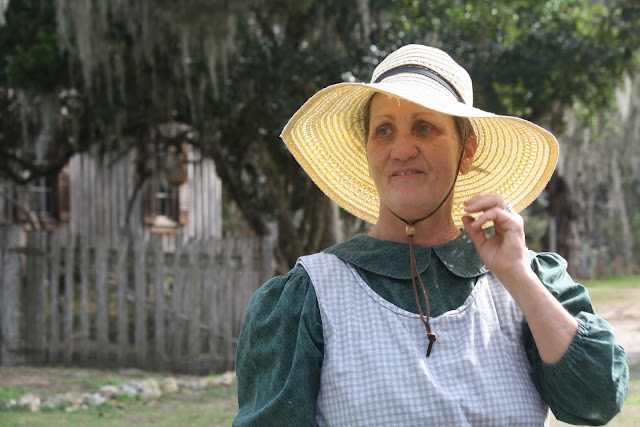
We talked to a wonderful lady named Terry who told us that she was soon retiring (one of very few paid staffs—I think one of two). She had grown up on a farm and had done much of the heavy labor in the restoration process. Split rail fences and gardening were two of her specialties. The physical labor is getting too much for her. She did say that she would like to remain as a volunteer.
Steve is interested in building a draw horse. Terry’s father had made the one used on the farm. She let the rope down and invited Steve to try it (something not usually done for touring folks). She also mentioned that she still had the drawings and would send them to us. A most charming and helpful lady. One could tell that she REALLLLLY loves her job.
Live stock currently includes a couple varieties of chickens, horse, mule, and two turkeys—the thirty pound tom with an “attitude.”
Crops include sugar cane, sweet potatoes and field corn. Mules are still used for the cultivation. Due to a recent killing frost, the banana trees were a wintery shade of tan, but they will come back in the spring. Many of the flowers in the front of the homestead looked pretty good, however. Some of the trees were a hundred or so years old.
Eighteen historic structures made the farm totally self-sufficient. Some of these buildings include:
The farm house was built by Ben Dudley. Four rooms arranged around a central hall. Boys slept upstairs and girls downstairs.
As was oft the tradition in the South, the kitchen and dining area were housed in a separate building. There were at least two reasons for this: (1) The heat in the summer would have made the house unbearable and (2) There was always a concern about fire hazard. If there was a fire in the kitchen, the rest of the house would have been kept safe.
The “flower pit” was built by Myrtle and Winnie Dudley as a kind of green house.
Dairy shed/canning house—an area for “women’s work.” Making butter, cottage cheese, canning farm produce and laundry.
Chicken coops housed 600 chickens in the 1930’s. Brooder house was built for raising baby chicks.
Sweet potato cellar—a general “root” A-frame cellar. This family used it primarily for their produce of sweet potatoes.
Syrup House Complex—The cane mill was powered by mules. Various times of the year, the complex was used for different chores—soap making, sugar cane syrup making, lard processing,
Smoke house, corn crib, stable, hay barn, tobacco barn.
Farm equipment and implements from the early days to “modern”-- early 1900’s) including a fairly early John Deere tractor which Ben traded for two of his mules. Various carts, wagons and pull sleds used by various animals were abundant Great antiques which have been preserved in the various buildings, including the house. At one time, one of the buildings housed a general store and local post office. The mail was received twice a week, and the locals came, met and gossiped. The general store has been restored with the types of inventory that would have filled its shelves.
A cistern collected rain water. And a water tower (no longer in existence) further collected water for the times during the year when rain was scarce.
I bought a great quint little cookbook in the gift shop Cookhouse Cookin’. It includes many family recipes and a hand-written recipe from Myrtle.
It was great fun and educational. All five of us enjoyed this portion of our trip.


Banana trees killed by frost


Steve at the draw horse

The back porch

Wonderful, hardworking Miss Terry

But Steve wanted to show Don and Peg a different part of the real Florida.So, after a couple of hours, we piled into the car once again and drove off to Manatee Springs.(See separate posting).


Monday, November 21, 2011

Ocali Days at Silver River Museum and State Park


Don'tcha love the foundation?


Silver River State Park and Museum
1425 N.E. 58th Avenue
Ocala, Florida 34470

(352) 236-7148

8 a.m. until sundown 365 days a year.

Park Admission Fee:
$6.00 per vehicle. Limit 2-8 people per vehicle.
$4.00 Single Occupant Vehicle.
$2.00 Pedestrians, bicyclists, extra passengers, passengers in vehicle with holder of Annual Individual Entrance Pass.
$2.00 per person. Entrance to the Silver River Museum and Environmental Center, which is open weekends and major holidays from 9:00 am to 5:00 pm. Children under six are free. The park is home to the Silver River Museum and Environmental Education Center. The center is operated by the Marion County School District in cooperation with the park and is open to the public on weekends and holidays from 9:00 a.m. to 5:00. p.m. For more information see website for Silver River Museum. The Pioneer Cracker village is open only once monthly to the public. Check the website for monthly date. A volunteer who once lived in a Cracker-style home will help you step back in time to life in Central Florida in the 1800's, a fascinating glimpse into our historic past--houses, school house and smithy.

Special fees apply for special events and festivals (Ocali Days—park entrance fee waived, entrance to museum and village $5.00 adults; children under 6 free). Check website for fees for other events)
See website for pavilion and camping fees

One of the park’s great festivals is Ocali Days!

Capt'n Connie
Steve has been volunteering at Silver River Museum located at the Silver River State Park in preparation for Ocali Days (November 8-November 11 for school children and November 12 and 13 for the general public this year). He originally volunteered to be First Mate on the pontoon boat used for the youngsters in the Marion County School System. But that is a very popular volunteering position.

Therefore, his chance in the rotation is slow (although he did have three shots at it in three weeks). They have discovered that he is a good handy man and carpenter and have used his skills, accordingly. He has been there two or three days a week for the last several weeks, helping Ricky.


His handiwork
One of the jobs Steve had done was to stain the benches in the school house that had been used in the Ocala area in a "black" one room school when segregation was still in effect in southern states including Florida up till the time when integration was Federally mandated.  Although a bit later in history than the other buildings and reproductions, this school was relocated to the Cracker Village to save it and use it as an educational example.

The classroom
Designed and made by Steve to aid in Candle Dipping


He worked with Ricky on Monday, November 7 for the final day of getting ready. Tuesday through Friday he cut and sold sugar cane. A piece about a foot long sold for fifty cents. Over 4,000 students came through the event over the four days…Marion Public schools, Private and Christian schools, and many homeschoolers, Most of the students were fifth grade or under. All seemed to enjoy themselves. When I asked if they had learned anything, the teachers, parents and other chaperones were quick to answer for the kids in the affirmative.

Steve also wanted to sell some of his handicrafts. Buddy-boy, y’all can’t do both volunteering and selling. So, Tuesday and Thursday, I sat at our tent. Thursday, I did my early American flag presentation, so at least I felt that I was at least volunteering on some level. I had not been on the volunteer schedule, so that worked out okay. Wednesday, I floated. Friday, Saturday and Sunday I worked as the local laundress. (more about these later). We were closed Friday as we both “volunteered.” Saturday and Sunday Steve sat in our sutlery.


Steve sold two tables and a bird house (to his Primary Care Physician—of all people--who had come with his wife and two boys) and a couple of his toy guns. He was a bit disappointed with this number, but any time he sells is a good thing. In addition, I carry stripped thigh high socks in many colors—black and yellow, red and white, blue and gray…well, you get the picture. Over the course of six days, ten pair were sold. We have never sold that many at any event. We also carry stuffed animals…mostly horses. The pink horses are my best seller.
This park is located in the eastern part of Ocala (Silver Springs area). And Ocala, of course, is the city who claims to be the Horse Capital of the World. (I am sure there are other places that would dispute this claim, but there are approximately a half million horses in Marion County—where Ocala lies—and the adjoining next door neighbor--Levy County—part of the greater Ocala area. Many famous or near famous racing horses have at some portion of their lives resided in the Ocala area. Some were bred and/or born in the area; many trained on one of its many training race tracks. Ocala area can, therefore, present a good argument for its claim to the title.)
Fred--Love those Springers
He belongs to Ron
There were vendors and exhibits for the kids all week, but Saturday and Sunday, the numbers of both of these—exhibitors and vendors--exploded. My fellow reenactors/time period sensitive vendors—Bubbles and Ron, the Spotted Pony, the Poindexters, Wooden Hawk, Mr. Monty’s Toy Emporium—were among the many.


A petting zoo. A chance to touch all kinds of arachnids and super-sized insects. A visit with raptors. And, of course refreshments in the form of bbq and other yummies.
There was much to see and do within the village. The volunteers overseeing the cane sugar mill got volunteers from the kids (and some adults) to push the large wooden pole that-- when rotated-- crushed the cane into liquid. This would then be brought to an area where it was heated and syrup became a viable product.
Wednesday, when I floated, I had the opportunity to work in the school house—which carries a cross on its roof as it is also used as church on Sunday (so much for early “separation of church and state.” My editorial is that our early pioneers had no such idea in mind. Those people today who are promoting such bonk are not reading their history, as the first amendment indicates that the government shall not impose a given religion. My opinion only…not necessarily that of the park).
The next place in which I substituted to give the regular volunteer a break was a replica of a Cracker House called the Godwin House. It has two main rooms with a detached kitchen. Kitchens, particularly in the South, were often detached for at least two reasons. One is that it is hot down here. Cooking away from the main house would keep the house itself cooler. The other, and probably the main reason, is that if the fire in the kitchen expanded beyond its fireplace or stove, it would be much easier to replace the one small room than it would be to lose the entire house. Lots of period items.

Friday through Sunday, I was the local laundress. Actually, I was the overseer, as it was set up for the youngsters to operate the entire wash system. Wash tubs. Scrub board. Rinse water. Wringer. It was amazing how many young people lined up to take his/her turn to scrub and wring the clothes. I equated the wringer to the spin cycle in Mom’s machine. Many returned several times to help with the laundry. I brought my own bar of lye soap, so that they could see what was used for the cleaning portion using the scrub board.
Behind me were Gene and Rosalie. Gene had been born almost locally in rural Florida almost eighty years ago. He had lived through most of what was being exhibited, displayed, demonstrated and explained. He is a wealth of knowledge with a really great sense of humor and soooo many stories. He and Rosalie demonstrate the removing of dried corn from its cob and grinding it into grits and corn meal. Children are encouraged to participate in portions of the process. He sells both grits and corn meal by donation to help defray the cost of the corn, etc. He was a big help in some of the details about which I was not so sure. I am, as you know, a New Englander. Some of my history details are not the same as local, in part due to the difference in climate; and, thus, agriculture, etc.
Spinning wheels. Smitty. Shaving Horse and other old time tools. Cracker Cow Camp (complete with a Cracker horse and a pregnant Cracker cow). Confederate Infantry camp. Union artillery camp (y’all, your cannon was facing the wrong direction…the Confederates were behind you, not in the direction the cannon was facing) with somewhat an hourly firing. 54th Massachusetts (colored troops—not PC for 2011, but appropriate title for the time period). Authors. Native American camp. An operating telegraph service. And so much more.
The school house offers some classes. The interior was a series of benches with a desk-like elongated board on which slates could be placed. Much of early education consisted of learning various information in either a poem or in a sing-song manner (A, B, C, D, EFG, etc.). On the back of many of the slates was a poem about the Presidents up to Benjamin Harrison. Children in our early days knew the names of all these men. Very few people can do that today (I can, but I’m weird). There are also some period “toys”—marbles, tug-of-war rope.

Sunday morning, in the school house, there was a short, very nice church service before the park opened.
The event gives kids and adults lots of hands on learning experiences. So much fun for both the public and those of us who volunteer. Keep early November available and put this on your calendar. If in the area, one should not miss this festival. Lots of work. Lots of fun.  Thanks, Scott, for this opportunity!


Love those huskies. 


Jerry and helper at cane press

Smitty (blacksmith)


Cracker Horse
Cracker Cow (she's five months pregnant)


Atop the Cracker School House

Godwin house kitchen
Cracker Village School House
Take my picture, please!


Miss Molly's domain

A little knuckle wrecking scrubbing

rub-a-dub dub, soap in the tub


The END